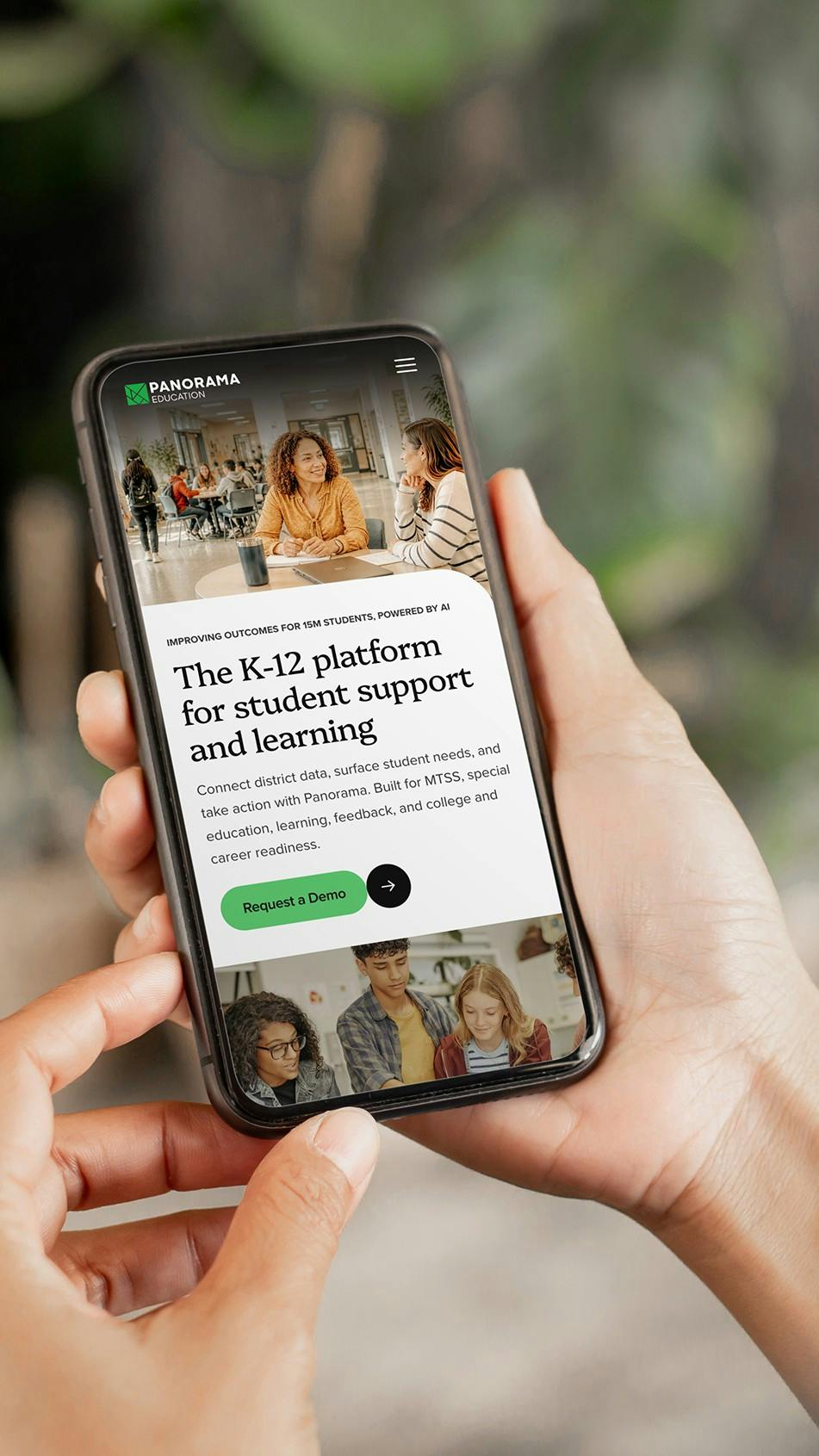
A full platform comes into focus
- Website Strategy
- Information Architecture
- UX Design
- Web Design
- Visual Design
- Design System
- UI Illustrations
- Motion Prototyping
- Contentful Development
- Frontend Development
- Content Migration
- Accessibility
- Launch Support
- Launched in 3 months, on schedule
- 200+ pages migrated off HubSpot
- Accessibility 100, Google PageSpeed
Panorama Education has spent 14 years in K-12, and most of the market still knew it for one thing: surveys. The company had grown into a multi-product platform for district and state leaders across student support, special education, instruction, and college and career readiness. Its HubSpot site had not kept up: product screenshots, formulaic panels, telling instead of showing. A new brand and positioning were ready. Back-to-school season fixed the deadline.
ANML partnered with Panorama Education to rebuild the site as the front door to the platform story. We set the information architecture, translated the new brand into a digital design system, and designed 13 page templates and a shared component library. We modeled the content in Contentful CMS, migrated 200+ editorial pages off HubSpot, and built the front end on Next.js on Vercel. Working alongside Panorama's brand and SEO partners, the site went live roughly three months after kickoff, on the date set at kickoff.


Teachers drive most of Panorama's traffic, but districts and states sign the contracts. So the homepage speaks to superintendents and cabinets: the new brand extended onto the web, one narrative from student data to district action, AI as proof of the platform rather than the category, and custom illustrations of the product that strip the interface to the features that matter. Most visitors are not the buyer, and the site accepts that trade on purpose.


Panorama did not want every product page on the same template, because some products carry a data story and others an AI story. ANML's answer: defined page types, each with its own hero and a flexible page builder, components scoped to the templates they belong to, and custom UI illustrations so each product shows what it does without a raw screenshot. Marketers compose distinct pages; the system keeps the guardrails.


Panorama asked for purposeful motion, not heavy scroll animation on every module. Rather than annotate it, ANML used Claude to build working motion and interaction prototypes from the Figma designs, so the platform scroll, product cards, and animated graphics were reviewed as they would behave. The same prototypes went to development as reference. Fewer interpretation gaps, and the motion on the live site matches what the client approved.


Roughly two-thirds of Panorama's sessions arrive through search, so a CMS migration was the single biggest threat to traffic. ANML preserved SEO metadata through the migration, put redirects on the CMS layer where the team can edit them, gave every page its own schema with a global fallback, and shipped an llms.txt file for answer engines. Redirect QA ran with Nexus, Panorama's SEO partner. Search and AI discoverability were one problem.
Panorama's brand agency, Kuya, delivered the new identity. ANML extended it into a digital design system: type, color, spacing, component patterns, and motion, with agreed room to adapt elements for the screen. The system ships as a live style guide on panoramaed.com, so developers built from the same reference the designers worked in, and Panorama's team has it as new pages are composed.


The new site runs roughly a dozen marketing and analytics tools, and that load falls hardest on mobile. In the first week of post-launch support, ANML deferred non-critical scripts so they no longer block rendering, replaced several multi-megabyte homepage images with optimized responsive versions, and preloaded fonts and the hero image. The homepage now scores 96 on Best Practices in Google's PageSpeed audit, above the previous site's 92.
FAQ
What did ANML do for Panorama Education?
ANML rebuilt panoramaed.com around the platform story: website strategy and information architecture, UX and visual design, a digital design system extended from the new brand, 13 page templates with a shared component library, the content model in Contentful, migration of more than 200 editorial pages off HubSpot, and a Next.js front end on Vercel. ANML also prototyped the motion in working code and handled accessibility, SEO preservation, and the first weeks of post-launch tuning.
What platform did Panorama Education move to?
The marketing site moved from HubSpot CMS to Contentful CMS, with a Next.js front end deployed on Vercel. Contentful already ran Panorama's product platform, so the new site extends existing infrastructure rather than adding another system for the team to run.
Did ANML create Panorama Education's new brand?
No. Panorama's brand agency, Kuya, developed the brand foundation and positioning. ANML translated that foundation into a digital design system and applied it across every page template and component, with agreed room to adapt elements for the screen.
How did ANML protect Panorama's search traffic during the HubSpot to Contentful migration?
Roughly two-thirds of Panorama's sessions arrive through search, so the migration was treated as an SEO project from the start. ANML carried every page's metadata across, put redirects in the CMS layer so Panorama's team can edit them, gave each page its own schema with a global fallback, and shipped an llms.txt file for answer engines. Redirect QA ran with Nexus, Panorama's SEO partner, before launch.
How long did the Panorama Education website redesign take?
Roughly three months from kickoff to launch, on the date set at kickoff. Back-to-school season fixed the deadline, so ANML ran strategy, design system, templates, Contentful development, and content migration in overlapping tracks rather than in sequence, and used working motion prototypes instead of annotated handoffs to cut interpretation time in development.